Case study · E-Services Platform
KonektBarangay
Barangay e-services online: verified residents request documents and book claim schedules, and staff process them from an admin dashboard.
- Role
- Project Manager & Full-stack Developer
- Year
- 2026
- Type
- Web application
- Status
- Live
01 — my role
Project Manager & Full-stack Developer · Team project
- Led planning and delivery as Project Manager
- Built the app on Next.js and TypeScript, with Supabase for sign-in, the database, file storage and realtime updates
- Wrote the row-level security rules and database triggers that keep admin roles and approvals staff-only
- Built the three-step document request flow, resident ID verification and the admin tools
02 — key features
Resident ID verification
Residents upload a photo of a valid ID after signing in. Staff review it from the admin side and approve or reject it with a reason the resident can see, and document requests unlock once the resident is verified.
Guided document requests
Nine document types, from Barangay Clearance to First-Time Job Seeker, plus an "Other" option, in a three-step flow that ends with a summary the resident reviews before submitting.
Appointment calendar
A month calendar with hourly slots inside office hours (Monday to Friday, 8 AM to 5 PM). Fully booked and unavailable days are marked.
Admin tools
Staff verify residents, filter and search requests, update blotter cases and manage announcements, with live updates and notifications.
03 — key decisions
Enforce access in the database with row-level security
The rules hold even if someone calls the API directly, not just when they use the app.
Save a request only after the resident confirms the summary
Residents review the document, date and time before anything reaches staff.
Keep ID photos in a private bucket with short-lived signed links
Staff can verify residents without the IDs ever being publicly reachable.
04 — design
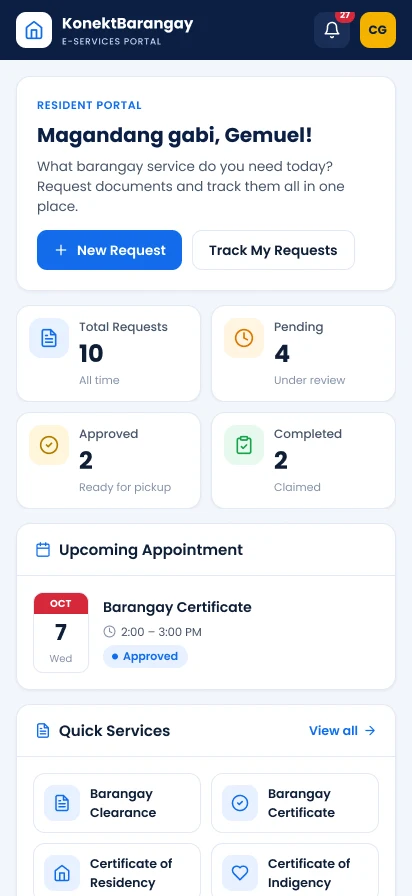
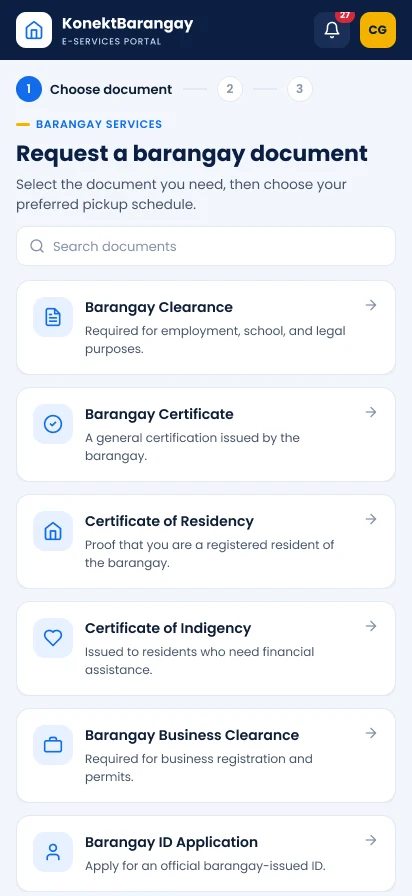
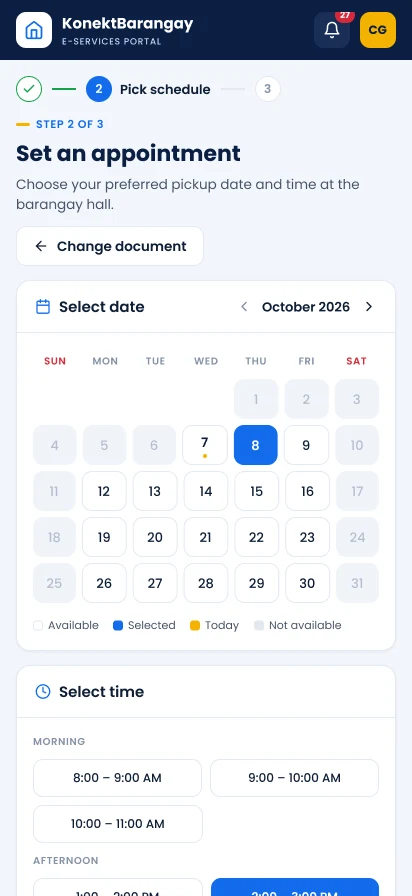
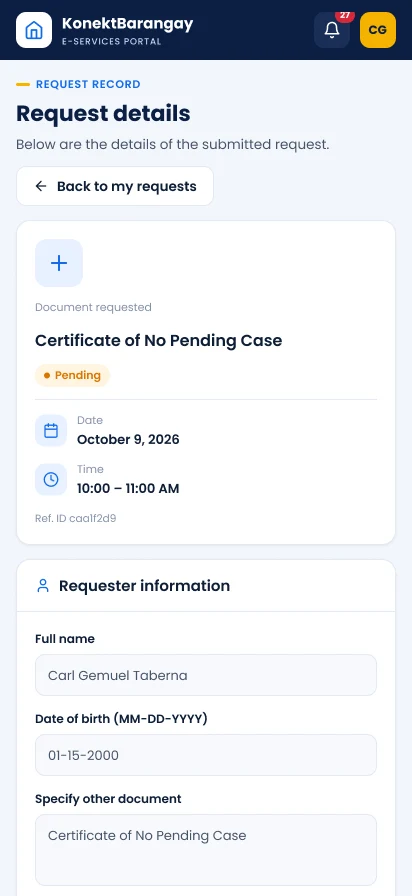
- A shared app shell gives residents and staff the same navigation on phone and desktop.
- The layout is built for phones first, since most residents are expected to use one.
05 — stack
- Next.jsApp Router pages and a proxy that guards resident and admin routes
- TypeScriptTyped pages, shared document and community models
- Supabase AuthRegistration, 6-digit email codes, password reset with codes, sessions
- PostgreSQLProfiles, requests, blotter reports, announcements and notifications with row-level security
- Supabase StoragePrivate bucket for resident ID photos, readable only by staff
- Supabase RealtimeLive admin queue, dashboard and notification badge
- Cloudflare TurnstileBot check on sign-up and login
- Framer MotionPage and component transitions
- VercelHosting with automatic deploys from GitHub